The Floor Runs Back
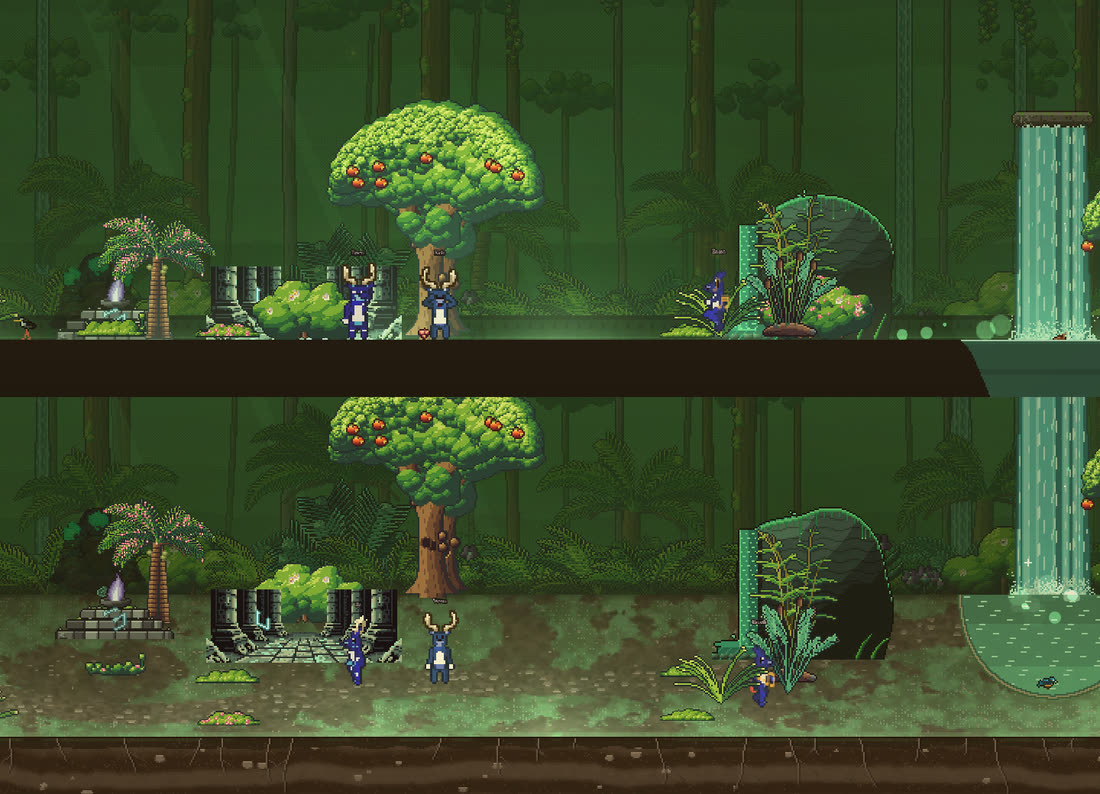
Precursors has always been a side view: a strip of ground, with everything standing on one line. In the 0.200 series the ground has depth. It runs back from the front of the screen, and everything on it stands somewhere along it. Nearer things are in front. Things further back are a little smaller and a little hazier.
This is simply how Precursors looks now, for every player, in every new game and every old
save. If you prefer the flat view, add ?terrarium=0 to the end of the
game’s address.
A floor with depth
Every creature now walks at a depth of its own. A walk wanders across the floor as well as along it, so a crowd spreads out instead of standing in a row. Plants stand by size: trees at the back, smaller plants in the middle, ground cover anywhere. Houses, landmarks and ruins each stand out on the floor in a place of their own.
Houses have sides and a roof now, and through a doorway you can see the floor inside running back. A cave is a real hole into the rock, and its floor climbs away into the dark. Ponds have a near shore and a far one, and Norns walk round by the shore instead of through the water. Creatures that breathe water stay in their pond and no longer end up stranded on the shore. Waterfalls come down at the back into their pond. Mist lies thicker toward the back and rolls slowly between the near ground and the far.
The small animals live in it too. Beetles, moths, birds and fish stand, fly and swim at their own depth. When you put something down, it lands on the part of the floor under your cursor.
Drawn by the game
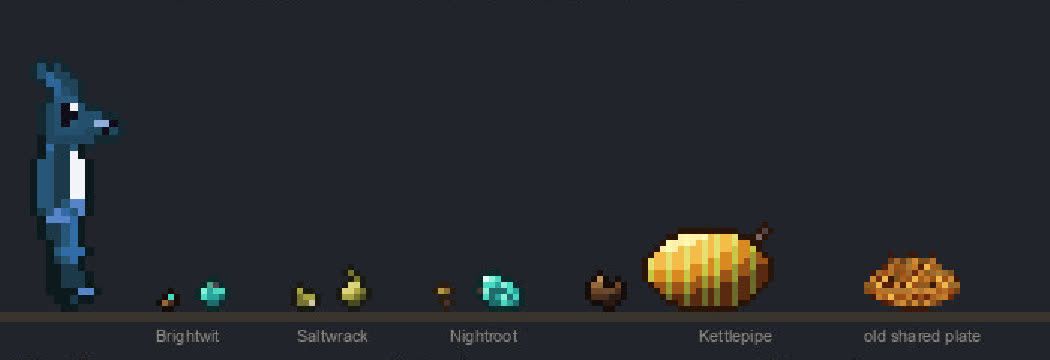
More of what you see is now drawn by the game itself, from a creature’s genes or a plant’s own data, instead of from fixed picture sheets. That matters because a drawing made from genes can change when the genes do.
Norns are drawn this way in every pose, and when you zoom out they shrink with the world around them instead of staying big. Every one of the 127 plant species now has its own seed, and the 52 that bear fruit have their own fruit, each at its own size. Most seeds are a few pixels across. The biggest fruit, a Kettlepipe gourd, is bigger than a Norn’s head. Landmarks and small animals are drawn by the game too, and each animal species comes in a few colourings. Every landmark is also named for what it actually is now.
Climbing
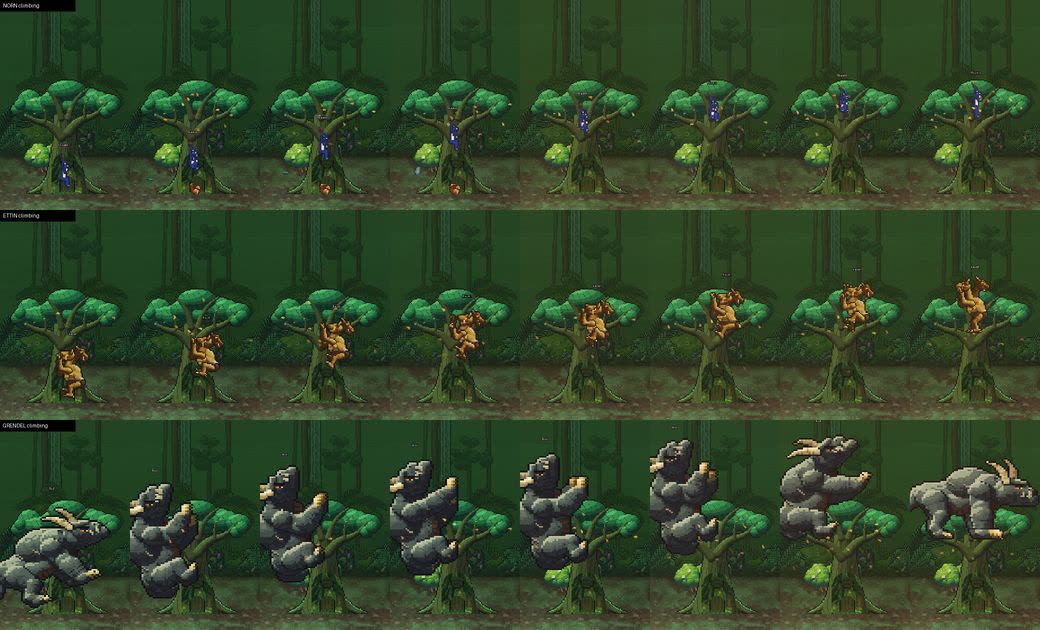
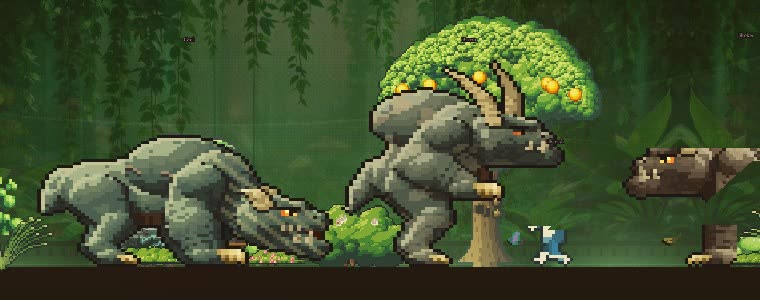
Norns, Ettins and Grendels climb trees now, each in its own body. A Norn goes up hand over hand. An Ettin hauls itself up side on with its long arms. A Grendel turns onto the bark and claws its way up. A hand or paw that has hold of the trunk stays where it is while the body rises past it.
A creature only picks a trunk at least one and a half of its own body lengths tall, so a grown Grendel no longer hugs a tree too small for it. Young Grendels still climb. It works for every inherited body, too: an Ettin climbs with its own arm length and build, and a Grendel line bred to stand upright drops onto all fours to climb.
Ettins, Grendels and Kitsuri, from their genes
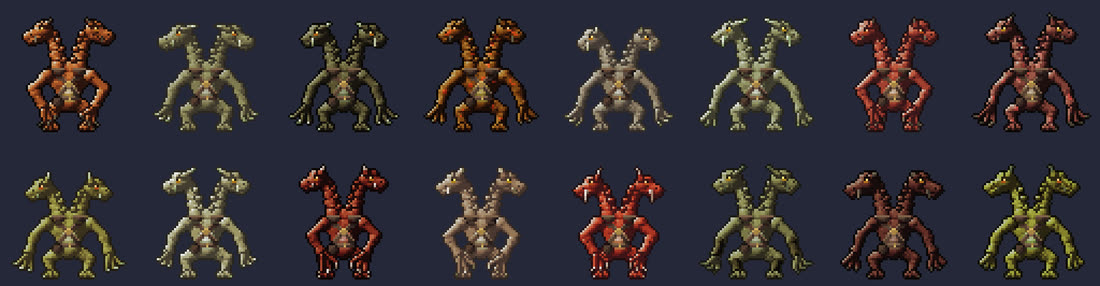
An Ettin’s body now comes from its genes: its heads, muzzles, jaws and necks, its horns and tusks, its fingers, claws, arms, legs and chest. Each of its two heads has its own feeling, and you can see which one is talking. The limits are wide, so a family line can drift a long way from its founders and still be drawn whole.
Grendels can evolve a long way too. Breed a line far enough and it can rise off all fours onto its hind legs, with its forelimbs hanging as arms. Its neck, ears, eyes, claws, the taper of its rump and the thickness of its limbs all come from its genes, and the game keeps reading them well past where the first Grendels started.
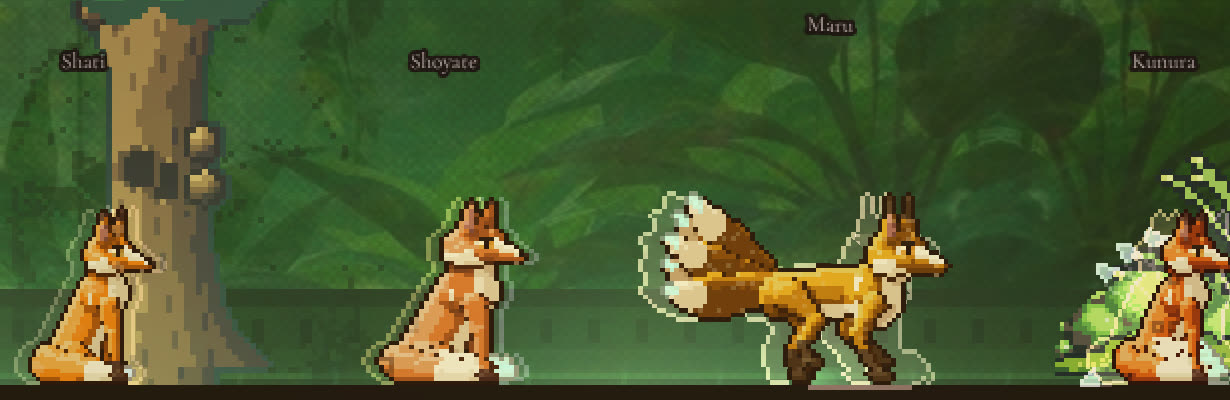
The Kitsuri are drawn by the game now as well. A Kitsuri trots side on with its feet planted, sits with its tails around it, and has its own way of doing everything it does: the tail-fan, the pounce, grooming, stretching, yawning, eating, singing and dancing. Its fox-fire burns on the tips of its tails. It burns bright when the Kitsuri is happy or working, dim when it is sad, and goes out when it is afraid. Its head, ears, legs, tails, coat and the colour of its fire come from its genes. A kit has one tail and big ears, and grows more tails as it ages, up to nine.
Toxins hurt
A Norn that eats something poisonous, or breathes bad air, now feels it. The pain depends on the toxin and the dose. The Norn says it feels sick, in words that fit: its belly, its head, dizzy, burning. Then it remembers what did it. It passes over that food afterwards unless it is starving, and it likes that room a little less.
Paint goes on something
When a Norn paints with ochre, the mark now lands on a real surface: a house wall, the ground, a landmark or the stone of a ruin. In 2.5D it sits at that surface’s depth. A Norn can’t paint on thin air, another creature, a plant or water. If it tries, no paint is used, and it remembers trying.
A map of the world
There’s a map of the world now, and you unlock it by playing. Once you have it, a small map sits in the corner of the screen as well. It shows the places your creatures have reached, with each creature as a dot, and a click on a place takes you there. Places no one has reached stay dark. How you unlock it is yours to find.
Shared worlds
Some of the land in Precursors is shared between players. If another player has already been somewhere and changed it, you’ll find it the way they left it when you get there.
Smaller things
- Windows you can move. The Recipe Book, machine consoles, Achievements and the mind settings can all be dragged, resized, docked or floated, and the game remembers where you put them.
- No more gliding backwards. Walks are stepped, and a creature faces the way it is going.
- Clapping stones in the paws. A Norn playing clapping stones now holds them and knocks them together.
- Enough is enough. Norns stop making a thing they keep, like clapping stones, once everyone in the room already has one.
- Desktop game updates are for buyers. The desktop app’s game downloads now need a purchase, like the installer always did. New versions need launcher 0.7.0 or newer.
- Vines hang from something. Every vine hangs from a tree’s crown or an overhang, never from bare ground or empty air.
- Warp, for us. The developer tools have a Warp menu that jumps the camera to any place or screen in the game and back again, without touching the save. It’s how we checked everything in this post.
Play it now at play.multiversegames.ai/precursors/ (or play.multiversegames.ai/precursors/). Pay what you can.